
GLP-1 Receptor Agonists in Research: Semaglutide, Tirzepatide, and the Incretin Axis Explained
An accessible deep-dive on GLP-1 receptor pharmacology, how semaglutide and tirzepatide are studied as reference compounds, and what the published literature actually reports about incretin signaling.
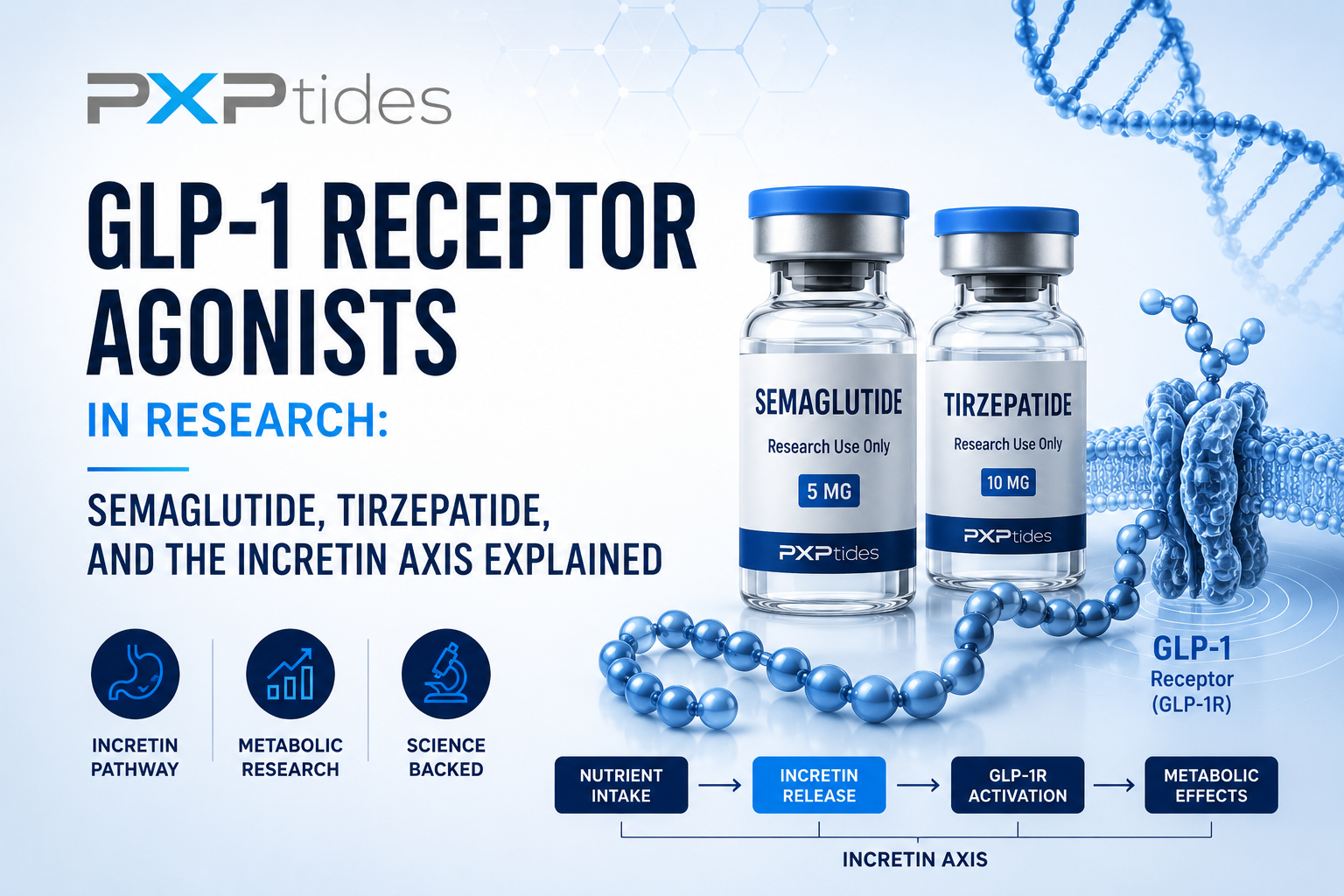
Few topics in modern peptide research have generated as much attention — or as much confusion — as the GLP-1 receptor agonists. Semaglutide, tirzepatide, retatrutide, and their cousins now dominate metabolic research papers, conference talks, and online discussion. The science underneath them is genuinely fascinating. This article walks through it in plain English, from the basic biology of incretin hormones to how researchers compare these molecules in the lab.
The incretin axis in one paragraph
When you eat, your intestine releases hormones called incretins. The two most important are glucagon-like peptide-1 (GLP-1) and glucose-dependent insulinotropic polypeptide (GIP). These hormones travel briefly through the bloodstream and activate receptors on cells in the pancreas, the brain, and elsewhere. The result is a finely tuned response to a meal: glucose-dependent insulin release, slowed gastric emptying, and signals to brain regions involved in appetite. The whole system evolved to handle nutrient intake gracefully.
The catch is that natural GLP-1 is fragile. An enzyme called DPP-4 degrades it within a couple of minutes. That is why pharmaceutical chemists spent two decades engineering synthetic GLP-1 receptor agonists that survive much longer in solution and in circulation.
Why agonists became such powerful research tools
The same property that made these molecules attractive to drug developers — long-lasting receptor activation — also made them indispensable reference compounds for receptor pharmacology. A researcher studying the GLP-1 receptor needs a compound that engages the receptor cleanly, consistently, and over a defined time window. Native GLP-1 cannot deliver that. Synthetic agonists can.
Three structural ideas made it possible:
- Sequence substitutions. Replacing the amino acids that DPP-4 normally cleaves makes the peptide resistant to that enzyme.
- Fatty-acid acylation. Attaching a fatty-acid chain lets the peptide bind reversibly to serum albumin, extending its presence in solution.
- Backbone modifications. Stapled, cyclized, or non-natural backbone elements add further stability.
Semaglutide combines several of these ideas. It is a long-acting analogue of native GLP-1, with an acyl chain that anchors it to albumin and substitutions at the DPP-4 cleavage site. Tirzepatide is structurally distinct — it engages both the GIP and GLP-1 receptors. Retatrutide is investigational as a triple agonist that adds glucagon-receptor engagement on top.
What "receptor agonism" actually means
A receptor is a protein on a cell surface (or inside the cell) that recognizes a specific signal. When the right molecule binds, the receptor changes shape and triggers a cascade of events inside the cell. An agonist is a molecule that activates the receptor; an antagonist blocks it.
GLP-1 receptors belong to a family called class B G-protein-coupled receptors. When activated, they primarily signal through a molecule called cyclic AMP (cAMP), which then ripples through downstream pathways. They also recruit a protein called beta-arrestin, which fine-tunes signaling and helps the receptor reset. Different agonists can bias the receptor toward more cAMP, more beta-arrestin, or a balance of both — a concept called biased agonism that researchers care about deeply because it influences which downstream effects dominate.
Reading a receptor pharmacology paper
When you open an in-vitro paper on GLP-1 agonists, the same handful of measurements keep appearing:
- cAMP accumulation assays. Cells expressing the GLP-1 receptor are treated with a range of concentrations of the agonist. The amount of cAMP produced is measured, and an EC50 — the concentration giving half-maximal response — is calculated.
- Beta-arrestin recruitment assays. Platforms such as PathHunter or NanoBiT detect when beta-arrestin associates with the activated receptor.
- Calcium flux assays. Used for some GPCRs to capture rapid intracellular signaling.
- Reporter gene assays. Cells engineered with a reporter that lights up when a particular pathway is activated.
These assays let researchers compare new molecules against established benchmarks under matched conditions. The trick is that EC50 values depend on the cell line, the receptor density, and the assay format — so comparisons across papers need to be read carefully.
Single, dual, and triple agonism — what changes
Semaglutide engages GLP-1R only. Tirzepatide engages both GIPR and GLP-1R. Retatrutide engages GIPR, GLP-1R, and the glucagon receptor (GCGR). Why would anyone want to hit more receptors? Because the incretin axis does not act in isolation. Different receptors regulate slightly different aspects of metabolism in the underlying biology, and engaging multiple receptors can produce signaling patterns that no single agonist would.
In matched in-vitro work, researchers have characterized how dual and triple agonists produce different cAMP profiles, different beta-arrestin recruitment, and different patterns of receptor internalization compared with single agonists. That comparative data is itself the value: it lets the field understand the rules of polypharmacology in this receptor family.
What the literature does — and does not — say
The published literature on GLP-1 receptor agonists is unusually rich. Pre-clinical studies in cell culture and animal models have characterized their pharmacology in depth. That body of work is genuinely informative for laboratory pharmacology.
What that literature does not establish — and what no honest commentator should claim — is that any specific research-grade material is appropriate for human use. The pharmaceutical-grade versions of these molecules went through years of clinical trials, dose optimization, and regulatory review before any therapeutic claim could be made. Research-grade material is not the same product, even when the chemistry is similar. The distinction matters for both legal and safety reasons.
A note on risks and unknowns
It would be inaccurate to suggest peptide research is risk-free. Even for the most-studied compounds, there are open questions about long-term biology, off-target effects, and how findings in cells translate to whole-organism physiology. In animal studies and clinical research on pharmaceutical-grade peptides, side effects have been observed and characterized. The conventional medical view that careful evaluation is needed before any therapeutic claim is sound — and reputable peptide researchers would agree.
Our position is straightforward: the in-vitro science is exciting, the receptor pharmacology is genuinely useful, and the molecules deserve continued study. Promising research is not the same as established treatment.
Handling notes for the lab
If you are working with GLP-1 family peptides as in-vitro reference compounds, a few practical notes:
- Reconstitution. Most are water-soluble and are commonly reconstituted in bacteriostatic water or sterile saline. Add solvent slowly down the side of the vial.
- Aliquoting. Once in solution, GLP-1 family peptides are not infinitely stable. Aliquot into single-use volumes in low-binding tubes and freeze at -20 °C or colder; -80 °C is preferred for longer-term storage.
- Freeze-thaw. Repeated freeze-thaw cycles degrade peptides. The cleanest data come from single-use aliquots.
- Documentation. Validate stability under your own laboratory's conditions before running quantitative assays.
A note on scope
This article describes the in-vitro pharmacology of GLP-1 receptor agonists. It is not medical guidance, does not describe human therapeutic use, and should not be interpreted as a recommendation for or against any clinical intervention. Clinical applications of pharmaceutical-grade GLP-1 agonists are regulated medical decisions that belong to qualified clinicians and their patients.
Bottom line
GLP-1 receptor agonists earned their place in modern peptide research because they unlock genuinely informative experiments. The pharmacology is rich, the comparative data across single, dual, and triple agonists is illuminating, and the field continues to refine its understanding of biased signaling, receptor trafficking, and downstream effects. Used as in-vitro reference compounds, these molecules are some of the most well-characterized peptides available to research. Treated as substitutes for medical care, they are something else entirely — and that boundary matters.