
Peptide Storage and Reconstitution: A Complete Best-Practices Guide for the Lab
A practical, end-to-end guide to handling lyophilized research peptides: receiving, solvent choice, reconstitution technique, aliquoting, freeze-thaw, working solution stability, and documentation.
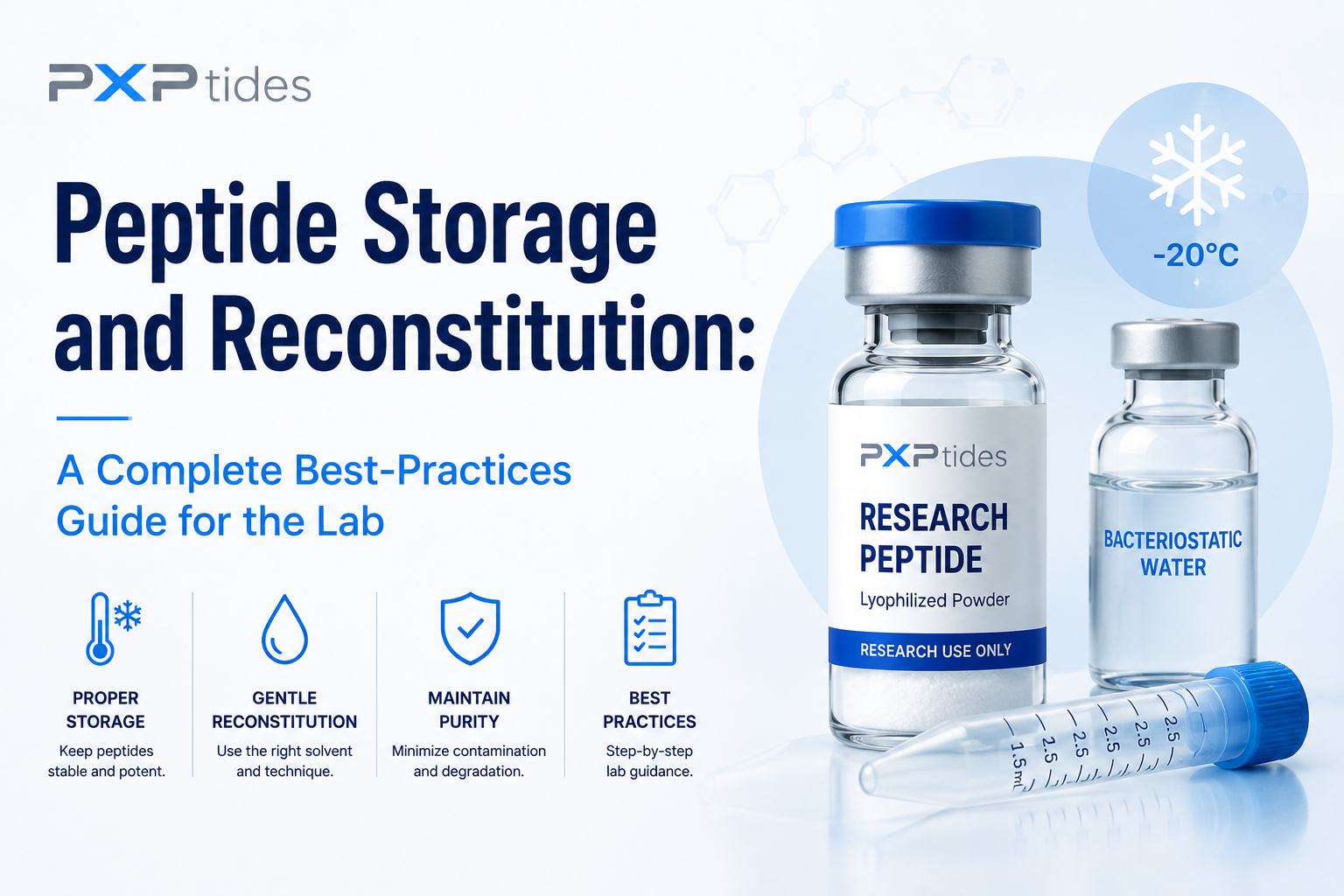
Good experimental data starts upstream of the experiment. A research peptide is only as reliable as the technique used to handle it from the moment the vial arrives to the moment the working aliquot is added to an assay. Poor reconstitution, careless freeze-thaw, or storage in inappropriate buffers can quietly degrade material and confound results long before anyone looks at the data. This guide walks through best practice end-to-end, drawing on conventions widely used in academic and industrial peptide labs.
Why handling matters more than people think
Peptides are not small molecules and they are not proteins; they sit awkwardly between the two. They are too large to be infinitely stable in solution like a typical pharmaceutical small molecule, and too small to enjoy the structural redundancy of a full protein. That means a peptide can lose activity in ways that are not always visible. A clear-looking working solution can quietly contain a degraded population, and assay variability can creep in for reasons that have nothing to do with the biology being studied.
The good news is that the steps that matter are mostly straightforward.
Receiving and inspecting the vial
When a shipment of lyophilized peptide arrives, do four things before anything else:
- Inspect the vial visually. A lyophilized peptide should look like a dry cake or a fine powder, sealed under inert atmosphere or vacuum. Visible moisture, a collapsed cake, or a damaged seal is a reason to document and contact the supplier.
- Log it. Record lot number, arrival date, COA reference, and where the vial is being stored. This is what makes results traceable months later.
- Centrifuge briefly if needed. A short, low-speed spin (or a firm tap on the bench) settles any peptide stuck to the cap or sides, so you don't lose material when you open the vial.
- Equilibrate to room temperature before opening. Opening a cold vial in a warm room invites condensation, which then sits with your peptide.
Choosing a reconstitution solvent
Solvent choice is sequence-specific. There is no single right answer for all peptides, but a few defaults cover most cases:
- Bacteriostatic water. Sterile water with 0.9 percent benzyl alcohol. A common default for water-soluble peptides used in in-vitro work because the bacteriostatic agent slows microbial growth in working solutions.
- Sterile water or saline. Used when benzyl alcohol could interfere with the assay or when the peptide is being used quickly.
- PBS (phosphate-buffered saline). Useful for assays that require buffered pH, but not all peptides are stable in PBS — check the literature for the sequence in question.
- Dilute acetic acid (typically 0.1 percent). Helpful for peptides that are not fully soluble in water alone, particularly basic peptides.
- DMSO. For hydrophobic peptides. Use as little as possible — DMSO can affect cellular assays at concentrations above about 0.1 percent in the final assay volume.
- Ammonium bicarbonate. Sometimes used for peptides that need slightly basic conditions.
When in doubt, consult published methods for the specific sequence. Suppliers often include suggested solvents on the product page or COA. Always validate solubility on a small scale before reconstituting a full vial.
Reconstitution technique
The technique is the same regardless of solvent:
- Add the solvent slowly down the side of the vial. Never jet it directly onto the lyophilized cake — that can foam the peptide and introduce mechanical stress.
- Swirl gently to dissolve. Do not vortex. Vortexing introduces shear forces that can damage peptide structure and create foaming.
- Give it time. Let the vial sit for several minutes (sometimes longer for slow-dissolving peptides) before drawing the first aliquot. Patience here is genuinely worth more than agitation.
- Visual check. A correctly reconstituted peptide should produce a clear or near-clear solution. Cloudiness or precipitation suggests an unsuitable solvent or incomplete dissolution.
Calculating concentration
For quantitative work, calculate concentration from net peptide content on the COA rather than the gross powder weight. Lyophilized peptide powders include counter-ions (commonly trifluoroacetate or acetate) and residual water, so the actual peptide fraction is typically 70-90 percent of the labeled mass for many peptides. Ignoring this can introduce a systematic offset in EC50 values that is hard to debug later.
Aliquoting
The single most impactful thing you can do for peptide stability is aliquot once and freeze. The rule of thumb:
- Use low-binding tubes to minimize adsorption to plastic, especially for dilute working solutions.
- Aliquot into single-use volumes that match a typical experiment, so you never need to refreeze.
- Cap tightly, label clearly (peptide, concentration, solvent, date, lot), and freeze.
For most research peptides, -20 °C is adequate for short-term storage (weeks). -80 °C is preferred for longer-term storage (months and beyond). Frost-free freezers can introduce temperature cycling — a dedicated, non-frost-free unit is preferable for sensitive material.
Freeze-thaw — the silent assay killer
Repeated freeze-thaw cycles are one of the most common causes of activity loss in peptide work. Each cycle introduces opportunities for aggregation, oxidation, and adsorption. The cleanest data come from single-use aliquots that are thawed once, used, and discarded.
If a multi-use aliquot is unavoidable, document the cycle count and consider running an internal stability check (for example, HPLC at intervals) to bound how many cycles your material tolerates without measurable loss.
Working solutions
Working solutions held at 2-8 °C have a finite stable window that depends on the peptide, the solvent, and the concentration. As a general guideline, many water-soluble research peptides are usable at refrigerator temperature for several days to a few weeks after reconstitution, but each laboratory should establish its own window based on internal data.
Two specific risks:
- Oxidation. Peptides containing methionine, cysteine, or tryptophan are particularly vulnerable. Working with degassed solvent and minimizing headspace in the storage tube both help.
- Adsorption. Dilute peptide solutions can adsorb significantly to plastic and glass. Low-binding tubes help, as does carrier protein (BSA) when the assay tolerates it.
Documenting stability
Stability is not a universal property; it depends on the peptide, the solvent, the temperature, the concentration, and the container. The most defensible approach is to perform an internal stability check under your laboratory's actual storage conditions — for example, HPLC at 0, 7, 30, and 90 days — and treat manufacturer or literature guidance as a starting point rather than a guarantee. Storing the resulting data alongside the COA gives future users of the material a real basis for trust.
Accessories that make life easier
Consistent results depend on consistent technique, and consistent technique is easier when the tools are standardized. A few small investments pay off:
- A reconstitution kit with sterile bacteriostatic water, alcohol pads, sterile syringes, and a mixing vial keeps every reconstitution identical regardless of who is doing it.
- Matching glass cartridges or vials make handling reproducible across users and lots.
- Low-binding pipette tips and tubes for dilute solutions.
- A clearly labeled freezer box with a logbook so the next person who walks up to the freezer can find what they need without thawing the wrong tube.
PXPtides supplies reconstitution kits and accessories that match the peptides on the catalogue, so the consumables side of the workflow stays consistent.
Bottom line
Handling peptides well is not glamorous, but it is one of the highest-leverage things a laboratory can do for the quality of its data. The steps are simple: inspect on arrival, reconstitute gently, aliquot into single-use volumes, freeze cold, avoid repeated thaws, and document everything. Done consistently, this routine turns research peptides into reliable experimental tools rather than a source of unexplained variability.