
What Are Research Peptides? A Complete Plain-English Primer for 2026
A clear, modern explanation of what research peptides are, why scientists study them, how research-grade differs from pharmaceutical-grade, and what 'for research use only' actually means.
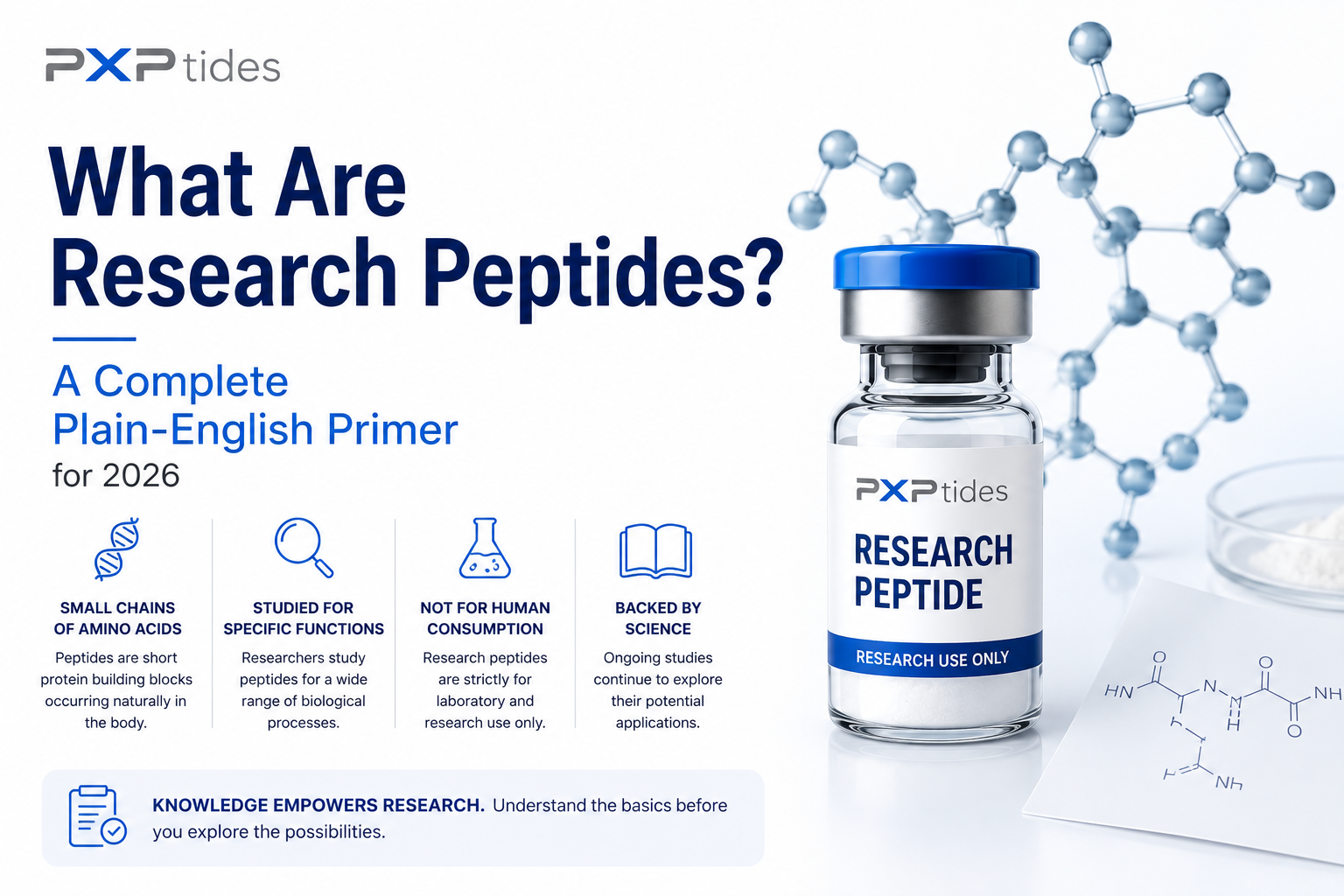
Peptides have quietly become one of the most studied classes of molecules in modern life science. They sit at the intersection of biochemistry, pharmacology, and regenerative research, and the volume of published work on them has accelerated dramatically over the last decade. For anyone new to the topic, the word "peptide" can sound intimidating. It isn't. This guide explains, in plain English, what research peptides are, why they matter, and what the label "for research use only" really means.
What is a peptide, really?
A peptide is a short chain of amino acids. Amino acids are the basic building blocks of biology — twenty common ones form virtually every protein in the human body. When a handful of these amino acids are linked together by chemical bonds called peptide bonds, the result is a peptide. When the chain grows longer (usually past around fifty amino acids), scientists start calling it a protein.
That size difference matters. Because peptides are small, they can be designed with remarkable precision. Researchers can synthesize a sequence atom by atom, swap one amino acid for another, and study how the change affects how the molecule binds to a receptor or triggers a signal inside a cell. That modular nature is exactly why peptides have become such powerful tools in laboratory pharmacology.
Why peptides have become so important in research
The body already uses peptides as messengers. Hormones such as insulin, glucagon, oxytocin, and the incretins GLP-1 and GIP are all peptides. Growth factors that orchestrate tissue repair are peptides or proteins built from peptide motifs. Even the immune system relies on peptide presentation to identify what belongs in the body and what doesn't.
Because peptides are natural information carriers, researchers have spent decades engineering synthetic versions that mimic, enhance, or block these signals to better understand how cells and tissues work. Several themes recur across the published literature:
- Metabolic signaling. Synthetic GLP-1 receptor agonists such as semaglutide and dual GIP/GLP-1 agonists such as tirzepatide are studied for incretin pharmacology and glucose-handling biology in laboratory models.
- Tissue repair and angiogenesis. Sequences such as BPC-157 and TB-500 (a synthetic fragment related to thymosin beta-4) appear throughout the wound-healing and connective-tissue literature.
- Growth-hormone biology. Ghrelin-mimetic peptides such as ipamorelin and analogs like tesamorelin are used as reference compounds when researchers want to probe the GH/IGF-1 axis.
- Cellular regeneration. Small copper-binding peptides such as GHK-Cu show up in fibroblast and skin-biology research, where investigators study extracellular-matrix gene expression.
- Mitochondrial and metabolic cofactors. Molecules such as NAD+ (often handled in the lab as a precursor or co-supplied reagent) are referenced in longevity-related cell research.
None of these uses imply human therapeutic intent. They describe what the published literature reports about cell-culture and animal models. The distinction matters and we will return to it.
Research-grade vs. pharmaceutical-grade peptides
This is the single most misunderstood point in the entire field. The same molecular sequence can exist in two very different worlds.
Pharmaceutical-grade peptides are manufactured under tightly regulated conditions, evaluated in formal clinical trials, sterile-filled in licensed facilities, and labeled and marketed as drugs. They are subject to oversight from agencies such as the FDA in the United States and the EMA in Europe. When a doctor prescribes a peptide medication, they are prescribing pharmaceutical-grade material with a specific dose, indication, and safety monitoring framework.
Research-grade peptides, by contrast, are made for the laboratory. They are typically supplied as lyophilized (freeze-dried) powders in sealed vials, characterized by techniques such as reverse-phase HPLC and mass spectrometry, and intended for in-vitro experiments by trained researchers. They are not sterile injectables, they are not packaged for human use, and they do not carry the regulatory clearances that medicines do.
The chemistry of the molecule can be similar. The intended use, the legal framework, and the quality-control workflow are very different.
What 'For Research Use Only' actually means
The phrase "For Research Use Only" (often shortened to RUO) is a formal designation. It signals four things at once:
- The material has not been evaluated or approved for any therapeutic use.
- The supplier is not making safety, efficacy, or quality claims relevant to human or animal consumption.
- The product is intended to be handled by qualified researchers under appropriate institutional and safety controls.
- Diversion of the material outside of research contexts is not permitted by the supplier.
Suppliers like PXPtides take this seriously. Every product page, every catalogue entry, every educational article carries the same message: peptides on this site are sold strictly for in-vitro laboratory research. That is both a legal requirement and a scientific reality. Research-grade material has not gone through the chain of testing that medical-grade material has.
How research peptides are characterized
Quality in this space is defined by analytics. A reputable supplier will publish a Certificate of Analysis (COA) for every batch of peptide. The COA typically includes:
- Identity by mass spectrometry. Confirms the peptide actually matches the expected molecular weight of the sequence. If the mass is wrong, nothing else matters.
- Purity by HPLC. Measures how much of the powder is the target compound versus impurities. Research-grade material commonly targets 98 percent or higher; well-run suppliers often achieve 99 percent or higher.
- Net peptide content. Lyophilized powders include counter-ions and residual moisture, so the actual peptide fraction can be slightly less than the total powder weight. This number matters for quantitative experiments.
- Residual solvents and water content. Some COAs include Karl Fischer water measurement and trace solvent analysis.
Lot-matched COAs let researchers tie their experimental results back to a specific batch of material, which is essential when results need to be reproduced months or years later.
What an in-vitro experiment with a peptide looks like
To make this concrete, picture a typical receptor pharmacology experiment. A laboratory has engineered cells that express a particular peptide receptor — say the GLP-1 receptor. They reconstitute the lyophilized peptide in a validated solvent, prepare a serial dilution, treat the cells with each concentration, and measure a downstream signal such as cyclic AMP accumulation. From that, they calculate an EC50: the concentration that produces half of the maximum response. That single number lets them compare different peptides on the same receptor under matched conditions.
Multiply that pattern across hundreds of receptors, dozens of cell types, and thousands of laboratories, and you have a sense of the scale of modern peptide research.
The honest picture: promising, but still being mapped
It would be misleading to suggest peptide research is settled science. Even the most-studied molecules in the field are still being characterized. What the published literature shows is encouraging — but also incomplete. Mechanisms are still being mapped. Long-term effects in living systems are studied case by case. Variability between laboratories is real, and reproducibility takes work.
That uncertainty is exactly why rigorous in-vitro research matters. It is also why the boundary between research material and medical product needs to be respected. The fact that a peptide produces an interesting effect in a dish does not mean it has been validated for any clinical use.
How to think about buying research peptides
If you are a researcher sourcing materials, three questions are worth asking of any supplier:
- Do you publish lot-matched COAs with both HPLC purity and MS identity?
- What is your storage and shipping chain for the material? Lyophilized peptides are generally robust, but extended exposure to heat or humidity is bad for any peptide.
- Can you provide chromatograms or mass spectra on request? Suppliers willing to share raw analytical data are easier to audit.
Reputable suppliers expect these questions and have answers ready. Vague responses are a useful signal.
Bottom line
Research peptides are precise, modular tools that have opened up entirely new lines of laboratory inquiry. When sourced from suppliers that publish analytical data, shipped under conditions that preserve integrity, and handled by qualified researchers, they enable some of the most informative experiments in modern biology. The science is moving quickly, the literature is rich, and the field continues to evolve.
At the same time, the line between research material and medical product is real and must be respected. RUO is not a marketing footnote; it is a statement of scope. PXPtides supplies these compounds strictly for in-vitro research, and every educational article on this site is written within that frame.