
How to Read a Peptide Certificate of Analysis (COA): A Researcher's Guide
Every research-grade peptide should ship with a lot-matched COA. Here is a full breakdown of what each section means, what numbers to expect, and what to insist on from a supplier.
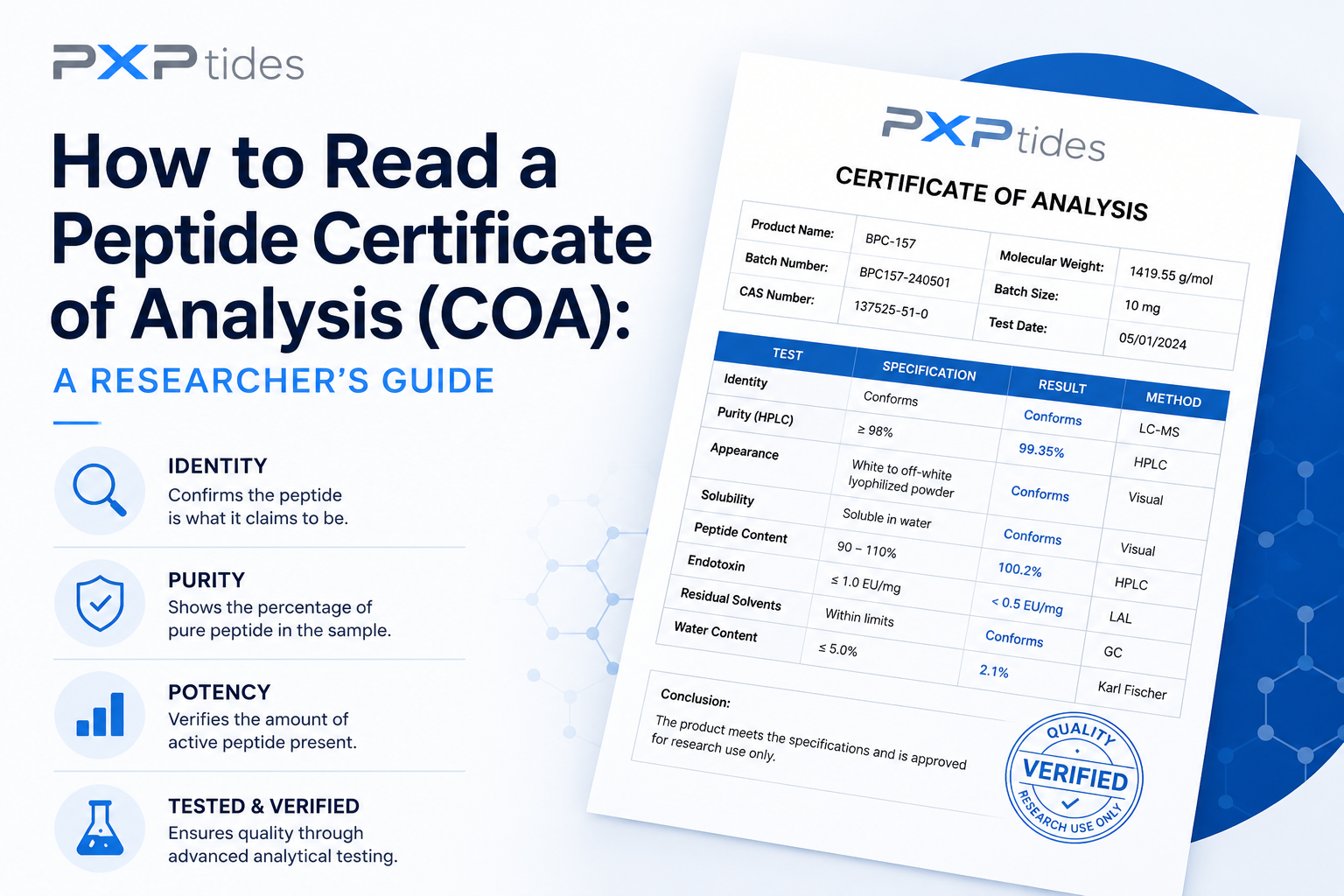
A Certificate of Analysis (COA) is the most important document that ships with any research peptide. It is the evidence trail that ties the material in a vial back to the analytical work done to characterize it. A good COA gives researchers what they need to trust the lot; a vague one is a warning sign. This guide walks through each section of a typical peptide COA in plain English so that you can read one with confidence and know what to ask for when something is missing.
What a COA actually is
A COA is a lot-specific document. That phrase matters. It does not describe what peptides of this type usually look like; it describes what this particular batch was measured to be. A "specification sheet" or a "typical analysis" page on a website is not a COA. A real COA has a lot number that matches the lot number on the vial, and the analytical numbers on the document were measured on that lot.
If a supplier cannot produce a lot-matched COA on request, that alone is reason to pause.
Identity
The identity section confirms that the material is the peptide you expected. The standard technique is mass spectrometry — most often electrospray ionization (ESI) or, in some workflows, MALDI-TOF.
What to look for:
- Expected mass (either monoisotopic or average, depending on the instrument and method).
- Observed mass, with a match to the expected value within instrument tolerance.
- The actual spectrum is sometimes attached as an appendix.
Watch out for COAs that list only a calculated mass without an observed value. That is a specification, not a measurement. A well-run analytical lab measures and reports both.
Purity
Purity is typically measured by reverse-phase high-performance liquid chromatography (RP-HPLC). The COA should state:
- Method. The column type, the gradient, and the flow rate are sometimes summarized.
- Detection wavelength. 214 nm is the most common because peptide bonds absorb strongly there; some COAs also include 280 nm where aromatic residues absorb.
- Main peak area as a percentage of total integrated area.
Research-grade peptides commonly target 98 percent purity or higher. Many suppliers, including PXPtides, target 99 percent or higher. Higher purity is not always strictly necessary — it depends on the experiment — but for quantitative assays it removes a source of variability.
Peptide content versus net weight
This is the section that catches researchers off guard most often. A lyophilized peptide powder is not pure peptide by mass. The powder contains:
- The peptide itself.
- Counter-ions from synthesis — most commonly trifluoroacetate (TFA) or acetate.
- Residual water that the lyophilization process did not fully remove.
- Trace solvents from purification.
"Net peptide content" on a COA tells you what fraction of the powder is actually peptide. Typical values fall in the 70-90 percent range for many sequences, though this varies considerably.
For quantitative assays — especially anything where you need to know exact moles delivered to a cell — net peptide content is the number that matters, not the gross weight on the vial label. A 5 mg vial with 80 percent peptide content gives you 4 mg of actual peptide. Pretending otherwise is one of the more common silent errors in peptide research.
Counter-ion identity
Related to the previous section: TFA versus acetate (or other salt forms) can matter for certain assays. TFA can have mild biological effects of its own at higher concentrations and is sometimes undesirable in cellular work; acetate is generally considered more inert. Reputable suppliers can confirm the salt form on the COA or on request.
Residual solvents and water content
Some COAs include:
- Karl Fischer water content. A direct measurement of how much water remains in the powder.
- Residual solvent analysis (gas chromatography). Confirms that solvents used in synthesis or purification have been removed below relevant thresholds.
These numbers matter for peptides sensitive to hydrolysis, for assays in which solvent carry-over could interfere, or for any storage decision that depends on baseline moisture.
Appearance and physical description
A typical COA describes what the lyophilized cake should look like: usually "white to off-white powder" or similar. This is what you should see when you open the vial. Discoloration, oily residue, or visible particulates do not match a normal description and are reasons to document and contact the supplier.
Storage and handling instructions
A COA typically restates baseline storage guidance: store the lyophilized vial at -20 °C or colder, protect from light, and reconstitute according to method. These are starting points; each laboratory should still validate stability under its own conditions.
Tying the COA to the vial
This is the single most important verification step. The lot number printed on the vial must match the lot number printed on the COA. If they do not match, you do not have a lot-matched COA. If a supplier provides a generic specification document instead of a lot-specific COA, you should ask for the lot-specific version before relying on the material for any quantitative work.
When to ask for more
For routine research a standard COA covers most needs. For projects where an experiment depends on a specific impurity profile, on counter-ion identity, on documented stability, or on the actual chromatograms, ask for the underlying data. A reputable supplier should be willing to provide:
- The full HPLC chromatogram, not just the percentage.
- The mass spectrum, not just the observed mass value.
- The peptide content method, when it matters.
- Storage history.
If a supplier is reluctant to share this material, that itself is information.
What a good COA looks like in practice
A clean, modern peptide COA generally fits on one or two pages and includes, at minimum:
- Supplier name and contact information.
- Product name and sequence.
- Lot number, manufacturing date, and recommended storage.
- Identity: expected mass, observed mass, technique.
- Purity: main-peak area percentage, method, detection wavelength.
- Net peptide content.
- Counter-ion identity.
- Physical description.
- Authorized signature or QA reference.
Anything significantly less than this is a partial COA, not a full one.
Bottom line
A Certificate of Analysis is the contract between a peptide supplier and the laboratories that use the material. It is what turns a vial of white powder into a trusted research input. Knowing how to read a COA — and what to insist on when something is missing — is one of the most practical skills any peptide researcher can develop. Suppliers that publish thorough, lot-matched COAs are easier to audit, easier to trust, and easier to defend in your own published work.