
Tirzepatide vs. Semaglutide vs. Retatrutide: A Research-Only Comparison Guide
Three of the most discussed incretin-pathway peptides in modern metabolic research. A clear comparison of single, dual, and triple receptor agonism — and how researchers compare them in the lab.
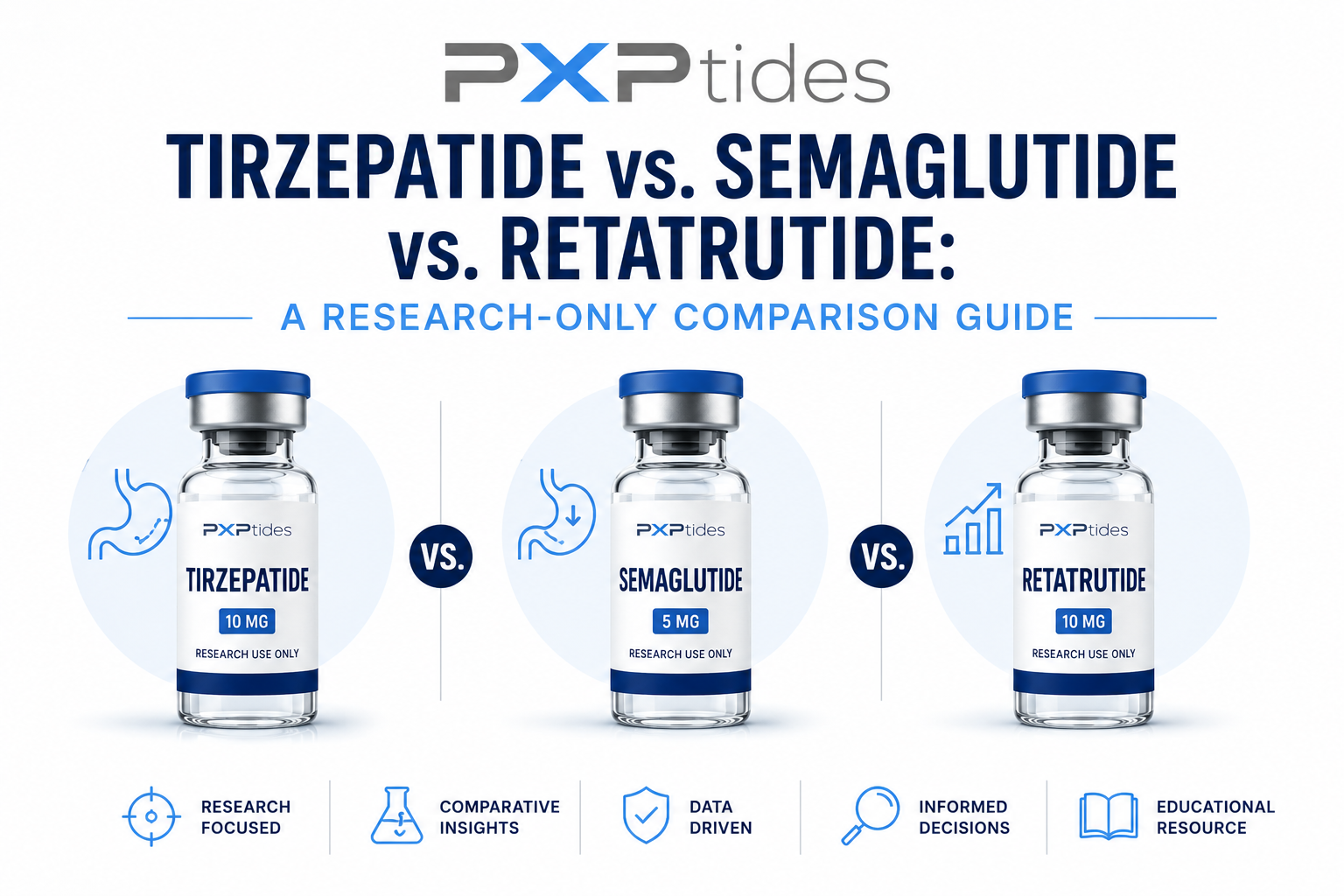
Three peptides dominate today's metabolic research conversation: semaglutide, tirzepatide, and retatrutide. They are often discussed in the same breath because they sit on the same biochemical axis — the incretin and energy-balance receptors that the body uses to coordinate response to nutrient intake. But the receptor pharmacology that defines each of them is meaningfully different. This guide walks through that pharmacology in plain English so researchers can read the literature with a clear mental model of what each molecule actually engages.
The receptors involved
Three receptors are central to the conversation:
- GLP-1R — the glucagon-like peptide-1 receptor.
- GIPR — the glucose-dependent insulinotropic polypeptide receptor.
- GCGR — the glucagon receptor.
All three are class B G-protein-coupled receptors. They share a basic architecture, and all three primarily signal through the second messenger cyclic AMP (cAMP). They differ in tissue distribution, in downstream pathway emphasis, and in the broader role they play in metabolic biology. In published in-vitro work, they are studied side by side because comparing how an agonist behaves at each receptor reveals the rules of the system.
Semaglutide: the GLP-1R single agonist
Semaglutide is a long-acting analogue of native GLP-1. Structurally, it incorporates sequence substitutions that resist DPP-4 cleavage and a fatty-acid acyl chain that binds reversibly to serum albumin, extending its presence in solution and in circulation. The result is a clean, selective GLP-1 receptor agonist with a long pharmacokinetic profile.
In receptor pharmacology research, that selectivity is precisely the point. Because semaglutide engages GLP-1R cleanly, it serves as one of the cleanest reference compounds available for any comparative GLP-1R study. When researchers want to ask "what does this new compound do at GLP-1R that semaglutide does not?" they have a well-characterized baseline.
In a typical in-vitro experiment, semaglutide is profiled in cAMP accumulation assays on cells expressing GLP-1R, often alongside beta-arrestin recruitment assays. The resulting EC50 values and signaling-bias measurements anchor the comparison.
Tirzepatide: the GIPR / GLP-1R dual agonist
Tirzepatide is structurally distinct from semaglutide and engages two receptors at once: GIPR and GLP-1R. From a research perspective, that dual engagement is what makes it interesting.
Why dual agonism? Because GIPR and GLP-1R are part of a single integrated incretin axis. Activating them together is not the same as activating either alone. The downstream signaling can differ in several ways:
- cAMP profile. The shape and time course of cAMP accumulation can differ across single and dual agonists.
- Beta-arrestin recruitment. Dual agonists can produce different patterns of beta-arrestin engagement than single agonists, which feeds back on receptor trafficking and desensitization.
- Receptor internalization. Different agonists can drive different rates of receptor removal from the cell surface, with implications for sustained signaling.
In matched in-vitro comparisons, researchers run tirzepatide against semaglutide on cells expressing each receptor separately, then on cells expressing both, to dissect what the dual engagement adds versus what is already explained by single-receptor activity.
Retatrutide: the triple agonist
Retatrutide is investigational as a triple agonist of GIPR, GLP-1R, and GCGR. Adding glucagon-receptor activity expands the pharmacological reach further. The glucagon receptor sits in a different part of the metabolic axis than the incretin receptors; engaging all three together is a deliberate exploration of multi-receptor pharmacology.
In comparative in-vitro work, retatrutide is profiled across the three receptors individually and in combination. The resulting EC50 values and signaling-bias measurements let researchers map the molecule's behavior across the relevant pharmacology and compare it with single and dual agonists head-to-head.
The broader research interest is not just in retatrutide itself but in what triple agonism reveals about receptor crosstalk. Engaging three receptors at once is a useful experimental probe even when the therapeutic implications are uncertain.
What a comparative assay actually looks like
A typical published comparison runs side by side under matched conditions. The setup might look like this:
- Cells engineered to express GLP-1R (or GIPR, or GCGR, individually).
- Same culture conditions, same vehicle controls.
- Serial dilutions of each peptide, applied for the same incubation time.
- cAMP measured (commonly with a homogeneous time-resolved fluorescence assay or a luminescence-based kit).
- EC50 calculated for each peptide on each receptor.
Then the same protocol repeats with cells expressing pairs of receptors, or with beta-arrestin recruitment as the readout instead of cAMP. The output is a table of pharmacology parameters that lets the field talk about these molecules in the same units.
Two practical points:
- EC50 values are context-specific. They depend on cell line, receptor density, and assay format. Comparing across papers requires care; comparing within a single matched study is more straightforward.
- Functional readouts complement binding studies. A high-affinity binder is not necessarily a strong activator. cAMP and beta-arrestin assays measure activation, which is what matters for understanding agonism.
A balanced view
The published in-vitro pharmacology of semaglutide, tirzepatide, and retatrutide is among the richest available for any peptide receptor family. The molecules are real, the receptor engagement profiles are well characterized, and the field has built a coherent comparative framework around them. That is a genuinely positive story for laboratory pharmacology.
It is also a story with boundaries. The pharmaceutical-grade versions of these molecules underwent extensive clinical trials before any therapeutic claim could be made about them, and side-effect profiles in humans are characterized through that clinical work — not through in-vitro studies. Research-grade material is a different product, intended for in-vitro work, not for human or animal use. Mature peptide research treats these two worlds as separate, and so does responsible educational content.
Handling notes for the lab
All three peptides are commonly supplied as lyophilized powders. Practical handling:
- Reconstitution. Water-soluble; bacteriostatic water or sterile saline is the typical default for in-vitro use.
- Aliquoting. Single-use aliquots in low-binding tubes, frozen at -20 °C or colder.
- Freeze-thaw. Avoid repeated freeze-thaw cycles. This is the single most common source of inconsistent results.
- Concentration. Calculate from net peptide content on the COA, not gross powder weight.
- Documentation. Lot-matched COAs with HPLC purity and MS identity are non-negotiable for quantitative work.
Scope reminder
This article describes receptor pharmacology and laboratory comparison only. It is not medical guidance, does not describe human or animal use, and should not be interpreted as a recommendation for or against any clinical intervention. PXPtides supplies these peptides strictly for in-vitro research; clinical applications of pharmaceutical-grade analogs are regulated medical decisions that belong to qualified clinicians and their patients.
Bottom line
Semaglutide, tirzepatide, and retatrutide are three points on the same incretin and energy-balance axis. The differences between them — single, dual, and triple receptor engagement — are not marketing categories; they are pharmacological realities that produce measurably different in-vitro behavior. Studied side by side under matched conditions, they form one of the most informative comparative pictures available in modern peptide research, while reminding us how much pharmacological complexity still sits inside a class of molecules that look superficially similar.